
For optical laboratories, distributors and retail chains, consistent RX lens quality depends on more than advanced surfacing equipment. The practical sourcing questions are whether prescription data is controlled, materials are traceable, digital surfacing is repeatable, coating performance is verified, and the finished lens is checked against the approved order before shipment.
A quality management framework aligned with ISO 13485 principles can support documented process control and traceability. For buyers, however, the most useful evidence is the actual production workflow: order review, material verification, digital surface generation, inspection, coating, final prescription verification and controlled packaging.

Illustrative view of the CONVOX RX production workflow, based on current workshop and equipment references. Equipment images are used here to illustrate the manufacturing workflow, not as a stand-alone compliance claim.
1. What Quality Management Should Mean in Digital RX Production
For a B2B buyer, ISO 13485 should not be treated as a marketing shortcut or a guarantee of customs clearance. The useful sourcing value is a documented system that helps control inputs, production steps, inspection records and corrective handling. In digital RX manufacturing, this means that the prescription file and selected lens design should remain linked to the material, production route and final verification record throughout the order.
- · Order data control: prescription values, design selection and required product configuration are reviewed before production.
- · Material traceability: substrate/index and functional configuration are identified before surfacing.
- · Process consistency: digital surfacing, polishing, cleaning and coating follow defined operating steps.
- · Verification: finished optical power and cosmetic quality are checked against the approved order requirements.
- · Documentation: quality records and technical documents can support customer audits and applicable market requirements.
2. RX Process Control and Quality Verification Map
The following framework converts quality-management language into practical checkpoints that an optical lab or distributor can evaluate during supplier qualification.
| RX Process Stage | What the Buyer Should Verify | Typical Quality Check | B2B Value |
| Order & Design Input | Rx values, lens design, index, coating and customization requirements are confirmed before production. | Order-data review and design-file confirmation. | Reduces avoidable production mismatches. |
| Material / Substrate Selection | The correct resin index and blank configuration are allocated to the order. | Material/index identification and batch traceability. | Supports repeat-order consistency. |
| Digital Surface Generation | Back-surface single vision or freeform geometry is produced from the approved design data. | Surface generation control and optical power verification. | Supports prescription accuracy and design repeatability. |
| Polishing & Cleaning | The surfaced lens is prepared without visible processing defects before coating. | Cosmetic inspection and surface cleanliness checks. | Reduces downstream coating and appearance issues. |
| Vacuum Coating | AR, hydrophobic and other functional layers match the ordered specification. | Coating appearance, adhesion and functional checks according to product requirements. | Improves consistency across repeat batches. |
| Final Verification & Packing | Sphere, cylinder, axis, prism and applicable design parameters are checked before dispatch. | Final lensometry / order comparison plus staged quality inspection. | Helps ensure the shipment matches the approved RX order. |
3. Precision-Controlled Digital Surfacing: Where RX Accuracy Is Created
Digital freeform production converts prescription and lens-design data into a controlled back-surface geometry. Rather than describing this process as “medical-grade precision,” buyers should evaluate how the supplier controls the design file, material selection, surfacing parameters, polishing and final optical verification.
The CONVOX catalogue documents customized RX production, German RX processing equipment and OptoTech design software references. For B2B sourcing, the important point is not the equipment name alone; it is whether the complete workflow can reproduce the approved prescription and design consistently across repeat orders.
A practical RX audit should therefore ask for representative samples, current material/design availability, expected turnaround by prescription complexity, and the supplier’s remake or corrective-handling process when an order falls outside the agreed specification.
4. Vacuum Coating and Surface Performance Control
After digital surfacing and polishing, coating quality becomes a separate control point. The CONVOX catalogue states that the manufacturing system includes 16 Korean NVC vacuum coating machines and supports anti-reflective and functional coating configurations. For an RX buyer, the coating should be evaluated as part of the finished prescription product rather than as an isolated marketing feature.
Useful checks include coating color consistency, cosmetic cleanliness, adhesion, hydrophobic performance and compatibility with the selected resin index. Where blue-block, photochromic or anti-fog functions are ordered, the relevant product specification should be confirmed separately rather than assuming that every coating configuration delivers the same performance.
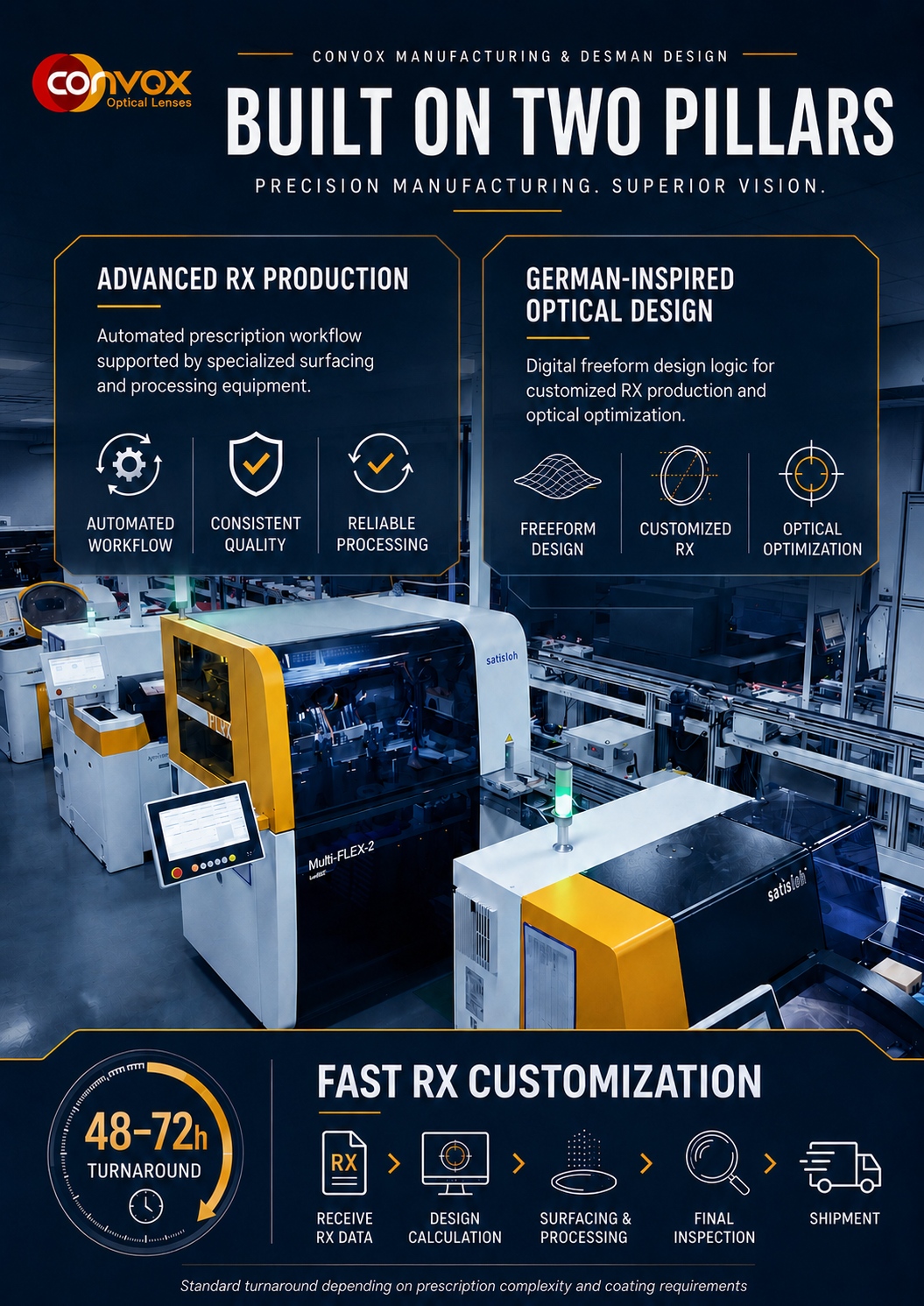
CONVOX manufacturing and DESMAN design overview: Korean coating know-how, German-inspired RX design and a 48–72 hour standard RX turnaround depending on prescription complexity and coating requirements.
5. Traceability, Inspection and Repeat-Order Consistency
The company catalogue describes staged product inspection and a modern storage system supporting ready stock and fast delivery. CONVOX quality-control materials also describe a staged inspection process for RX production and final verification. For global buyers, the commercial value of these controls is repeatability: the ability to reorder the same material, design and coating configuration with a consistent verification process.
Instead of relying on broad statements such as “every lens is perfect” or “zero human error,” a stronger B2B quality message is to define what is checked and what records can be provided. This is more useful for optical laboratories that need to qualify a supplier, investigate a remake, or compare batch performance over time.
6. B2B RX Supplier Qualification Checklist
- · Confirm whether the quoted quality-management certification or alignment applies to the actual manufacturing site and current scope.
- · Ask for the current RX material, index, design and coating matrix rather than relying on a general catalogue statement.
- · Request sample orders that represent both standard and complex prescriptions used in your market.
- · Verify how sphere, cylinder, axis, prism and progressive/design parameters are checked before shipment.
- · Confirm how coating defects, prescription deviations and remakes are handled and documented.
- · Check whether the supplier can trace an order back to its material and production records when a quality issue occurs.
- · Separate product compliance documents from manufacturing-quality certificates; requirements can differ by market and product.
7. FAQ: Digital RX Quality Management
Q1. Does ISO 13485 automatically guarantee prescription accuracy or customs clearance?
No single quality-management certificate should be treated as a guarantee of finished-lens accuracy or market clearance. Buyers should review the applicable certificate scope, product documentation and the supplier’s actual RX verification process.
Q2. What should be checked on a digitally surfaced RX lens before shipment?
At minimum, the finished lens should be compared with the approved order for optical power and applicable prescription parameters, while cosmetic surface quality and the ordered coating configuration are also verified.
Q3. Why does equipment matter if the quality system is documented?
Documentation and equipment serve different purposes. A documented process helps control how work is performed, while suitable digital surfacing, polishing, inspection and coating equipment enables the physical execution of the approved lens design.
Q4. Can CONVOX support customized freeform and functional RX configurations?
The CONVOX catalogue documents customized RX production, freeform capability, multiple resin indices, blue block, photochromic and other functional lens categories. Exact availability should be confirmed by index, prescription, design and coating requirement.
Q5. What should a distributor request before approving an RX supplier?
Request the current quality documentation, RX product matrix, representative samples, lead-time guidance, remake policy and a clear explanation of how prescriptions are verified before shipment.
Request RX Quality Documentation, Samples or a Product Matrix
For digital surfaced single vision, freeform progressive and customized RX sourcing, contact CONVOX to confirm current materials, designs, coating options, quality documentation and sample-order arrangements.
Website: https://www.convox-optical.com/ | Email: sales@convox.cn
Post time: Aug-20-2026