
Introduction
With the increasing use of digital devices and changes in lifestyle, myopia among children and adolescents has become a growing concern worldwide.
Uncorrected or rapidly progressing myopia can affect children's learning, daily activities and long-term eye health. Therefore, early detection, professional eye examinations and appropriate optical solutions are essential for effective myopia management.
This article explores the key aspects of adolescent myopia control, from eye examinations and professional optometry to lens selection and ongoing care.
1. The Importance of Professional Eye Examinations
Before choosing eyeglasses, children should undergo a comprehensive eye examination to identify the cause of reduced vision.
Vision problems are not always caused by myopia. Conditions such as amblyopia, strabismus and corneal disorders may also affect visual performance.
Cycloplegic refraction, commonly known as a dilated eye examination, is particularly important for children. By temporarily relaxing the focusing muscles, it helps eye care professionals obtain a more accurate measurement of refractive error and distinguish true myopia from accommodative pseudomyopia.
Regular examinations also help identify changes in eye health at an early stage.
2. Professional Optometry and Accurate Fitting
A reliable prescription requires more than a simple vision test.
Professional optometry should consider several factors, including:
- Refractive error: Sphere, cylinder and axis.
- Binocular vision: Eye alignment and coordination.
- Accommodation: The eyes' ability to focus at different distances.
- Pupillary distance and fitting height: Essential for accurate lens positioning.
After the examination, a trial frame assessment can help evaluate visual comfort and adaptation.
Accurate measurements and proper fitting are especially important when selecting functional lenses for children.
3. Choosing the Right Lens Materials and Frames
Lens material and frame design both influence wearing comfort, safety and optical performance.
Common lens materials include:
- Resin lenses: Lightweight and suitable for everyday use.
- Polycarbonate (PC) lenses: Offer high impact resistance and are suitable for active children.
- High-index lenses: Provide thinner and lighter lens options for higher prescriptions.
When choosing frames, parents should consider durability, flexibility, comfort and proper fit. The frame should remain stable to ensure that the optical centers of the lenses align correctly with the pupils.
4. Functional Lenses for Myopia Control
Traditional single-vision lenses correct blurred vision, but they are not specifically designed to slow myopia progression.
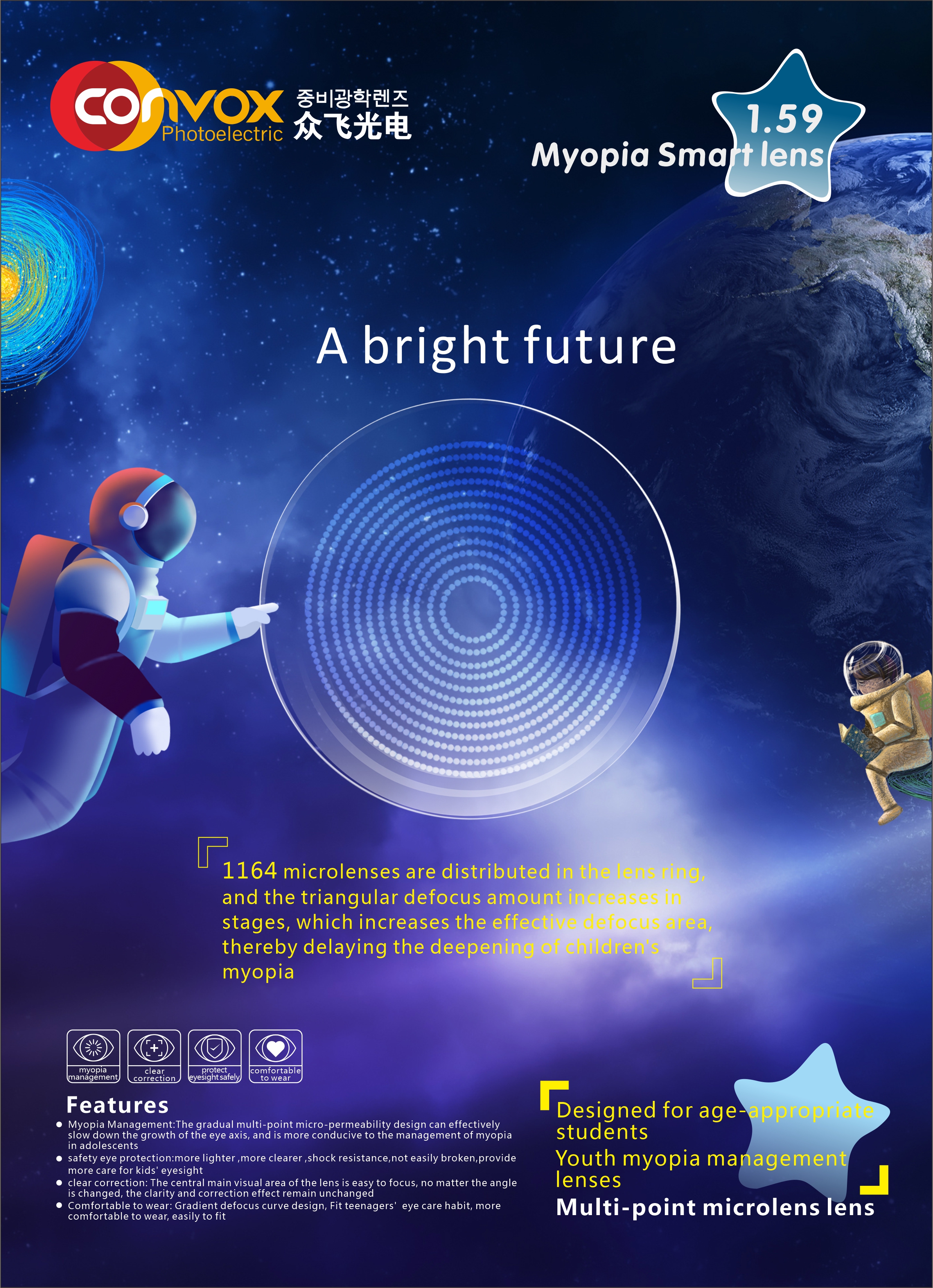
In recent years, specialized myopia-control lenses have attracted increasing attention. Technologies such as Defocus Incorporated Multiple Segments (DIMS) and other advanced micro-lens designs aim to provide clear central vision while introducing myopic defocus signals to help manage eye growth.
Key advantages of spectacle-based myopia-control solutions include:
- Non-invasive correction without direct contact with the cornea.
- Convenient daily wear.
- Specialized optical designs intended to slow myopia progression.
- An option for children who are suitable candidates for spectacle-based intervention.
The effectiveness of different designs may vary. Professional assessment and regular monitoring remain essential.
5. Long-Term Eye Care and Follow-Up
Myopia management is a continuous process rather than a one-time purchase.
Parents should arrange regular eye examinations, generally every 3–6 months as recommended by their eye care professionals. Monitoring refractive error and axial length helps evaluate changes and adjust the management plan when necessary.
In addition, several daily habits can support children's eye health:
- Spend at least two hours outdoors each day when possible.
- Follow the 20-20-20 rule during prolonged near work.
- Maintain an appropriate reading distance and good posture.
- Take regular breaks from electronic screens.
- Keep prescription records, invoices and warranty documents for future reference.
Conclusion
Effective adolescent myopia management requires a combination of early detection, accurate diagnosis, professional optometry, appropriate lens selection and regular follow-up.
With advances in optical technology, modern myopia-control lenses offer additional options for managing myopia progression. However, no single solution works for every child.
By combining professional eye care with healthy visual habits, parents and eye care professionals can work together to protect children's vision and support long-term eye health.
Post time: Nov-13-2026