
Introduction
With changes in modern lifestyles and the ubiquity of electronic devices, the prevalence of visual impairment—particularly myopia—among children and adolescents has shown a rising trend toward younger ages. Decreased visual acuity not only impacts academic performance and quality of life but high myopia can also lead to severe complications such as retinal detachment and glaucoma. Faced with a staggering array of optical retailers and functional lenses, how can parents choose a vision correction plan for their children that is both scientific and professional? This guide provides a deep dive into the dimensions of medical examination, optometric procedures, material selection, and functional defocus intervention.
Part I: Pre-emptive Medical Examination — Ruling Out Non-Refractive Vision Loss
Before deciding on a pair of glasses, the primary step is not measuring the prescription, but conducting a systematic ophthalmic medical examination.
1.1 The Importance of Differential Diagnosis
Many parents assume their child "has become nearsighted" as soon as vision drops. However, vision loss can be caused by various ocular conditions, such as congenital cataracts, keratoconus, amblyopia (lazy eye), strabismus (eye misalignment), or fundus (back of the eye) pathologies. Getting glasses directly without a professional diagnosis may mask these underlying conditions, leading to missed windows for critical treatment.
1.2 The Necessity of Cycloplegic Refraction (Dilated Eye Exam)
The accommodative (focusing) power of a child's eye is extremely strong. If the ciliary muscle is in a state of spasm, it can result in "pseudomyopia" or cause the true myopic prescription to appear higher than it is.
-
Atropine and Tropicamide: These pharmacological agents paralyze the ciliary muscle, allowing the eye to be in a completely relaxed state. This ensures the measurement of the true refractive error (baseline refraction).
-
Clinical Significance: For first-time wearers, younger children, or those with esotropia, cycloplegic refraction remains the "gold standard" for medical optometry
Part II: Professional Standards for the Optometry Process
Medical optometry differs fundamentally from standard commercial eye exams. It is not merely about finding a prescription; it is a complex biometric measurement process.
- 2.1 Verification of Credentials and Equipment
When choosing an optical facility, parents should prioritize medical institutions with medical practice licenses or reputable professional optometry centers.
-
Regulatory Compliance: Ensure the facility holds a production license, equipment calibration certificates, and that staff possess professional qualifications as optometrists or opticians.
-
Equipment Calibration: Precision instruments such as auto-refractors and phoropters must undergo periodic inspection by legal metrology departments and carry valid compliance marks.
2.2 Dynamic Refraction and Trial Wear Experience
Optometry should not be a rushed process. Professional optometrists evaluate the patient comprehensively, considering visual habits, eye alignment (phoria), and accommodative facility (BCC/PRA/NRA).
-
Trial Period: A trial wear of at least 20 minutes is recommended. Observe whether the child experiences dizziness, floor tilting, or image distortion during dynamic activities (walking, switching focus between near and far, or climbing stairs).
-
Re-examination Principle: Since the visual system is susceptible to fatigue and mood, a second examination at a different time of day is recommended for complex cases to ensure the stability of the prescription.
Part III: Material Science in Lenses and Frames
While the lens is the core of vision correction, the frame serves as the foundation of the optical system.
3.1 Comparative Performance of Lens Materials
-
Resin Lenses (Plastic): Currently the mainstream choice for adolescents. Their advantages include high impact resistance (safety) and light weight (reducing pressure on the nasal bridge).
-
Note: Resin lenses are less scratch-resistant than glass and have limited thermal stability. Temperatures exceeding 60°C (e.g., inside a car on a hot day) can cause coating cracks or substrate deformation.
-
-
PC Lenses (Polycarbonate): Known as "space lenses," these offer extreme impact resistance, making them ideal for highly active or athletic teenagers.
-
Glass and Crystal Lenses: Despite their high hardness, these are largely obsolete for adolescents due to their fragility and excessive weight.
3.2 Mechanical and Biocompatible Properties of Frames
-
Stability: Frames must maintain structural integrity to ensure the optical center of the lens remains aligned with the center of the pupil.
-
Material Safety: Prioritize silicone, TR90, or pure titanium. These materials reduce the risk of skin allergies and prevent sharp-force injuries in the event of an impact.
Part IV: Functional Defocus Lenses — The Frontier of Myopia Management
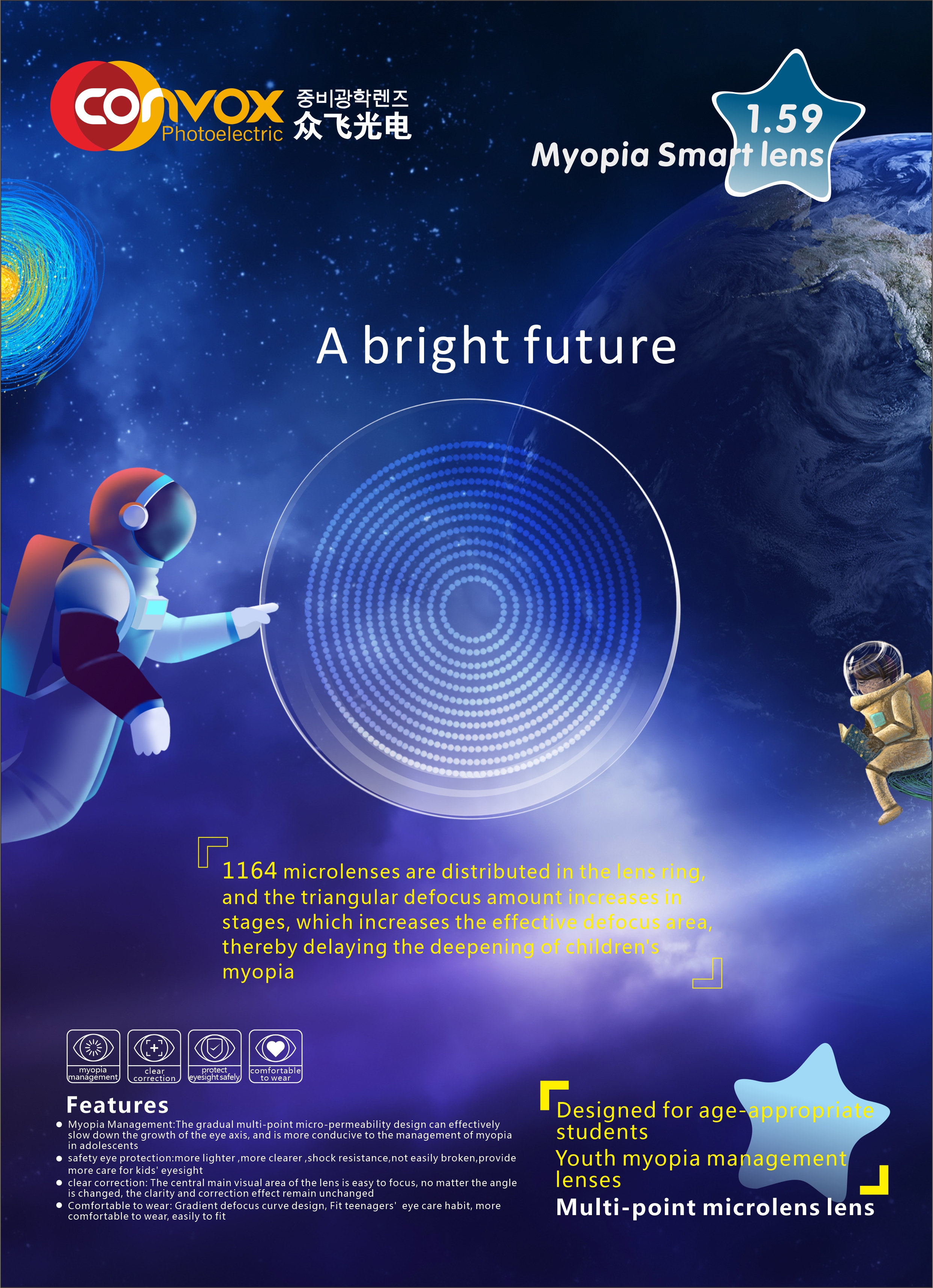
In recent years, standard single-vision lenses have often failed to meet parents' expectations for "slowing down prescription growth." Functional lenses utilizing Defocus Incorporated Multiple Segments (DIMS) or micro-lens technology (such as the Myovox defocus lenses) have become a focal point.
4.1 The Principle of Defocus in Myopia Retardation
Traditional single-vision lenses provide clear central vision but cause "peripheral hyperopic defocus." This state sends a signal to the brain that stimulates the eye to grow longer (compensatory axial elongation), thereby worsening myopia.
-
Peripheral Defocus Technology: By designing specific refractive zones in the periphery of the lens, the peripheral image is projected in front of the retina (myopic defocus), effectively inhibiting axial growth.
4.2 Advantages of Defocus Lenses
-
Non-Invasive: Unlike Orthokeratology (OK lenses), these do not touch the cornea, significantly reducing the risk of infection.
-
Visual Comfort: Utilizing asymmetric designs, they have a short adaptation period and effectively relieve visual fatigue during prolonged near-work (reading/writing).
-
Harmful Light Filtration: Combined with blue-light blocking technology, they protect the retina from high-energy short-wave blue light while maintaining high light transmission.
Part V: Post-Fitting Care and Consumer Rights
5.1 Monitoring and Adjustment
The first week after fitting is the adaptation period. If visual fatigue, double vision, or nausea persists after one week, an immediate follow-up is required. Adolescents should have their vision checked every 3–6 months to dynamically record changes in axial length (via IOL Master) and refractive error.
5.2 Protection of Legal Rights
Parents should properly retain the following documentation:
-
Optometry Prescription: Recording sphere, cylinder, axis, and pupillary distance (PD).
-
Warranty Card and Invoice: Ensuring product traceability and the ability to exercise warranty rights for issues such as coating peeling or frame breakage.
Conclusion: Scientific Prevention and Integrated Intervention
Fitting a child with glasses is not a simple consumer purchase; it is a rigorous medical decision. Parents should adopt a philosophy of "Prevention, Examination, Fitting, and Management." Beyond choosing professional defocus lenses, maintaining sufficient outdoor sunlight exposure (recommended 2 hours daily), following the "20-20-20" rule (looking 20 feet away for 20 seconds every 20 minutes), and ensuring proper posture are the ultimate solutions for safeguarding the visual health of the next generation.
Early detection, professional diagnosis, precise fitting, and regular follow-ups: let us work together to build a clear future for our children.
Post time: Mar-21-2026